
Fahrenheit to Celsius to Fahrenheit
Fahrenheit to Celsius to Fahrenheit — get instant, bidirectional results. Whether you are validating thermal round-trip accuracy for marketing automation server deployments, cross-checking AdTech real-time bidding appliance specifications, or aligning programmatic ad-serving infrastructure cooling with US facility standards, our Fahrenheit to Celsius to Fahrenheit tool delivers immediate precision in both directions.
Secure & Private: Any files processed on YellowPDF are automatically deleted after 1 hour.
Type into either field — the other updates automatically.

Why Fahrenheit to Celsius to Fahrenheit Conversion Is Critical for Marketing Automation Infrastructure
Enterprise marketing automation platforms and programmatic advertising technology stacks depend on high-density compute infrastructure that processes billions of bid requests, audience segments, and campaign triggers every hour. The hardware powering these platforms — real-time bidding servers, demand-side platform appliances, customer data platform nodes, and ad-serving render clusters — ships from manufacturers across Asia and Europe with thermal operating ranges documented exclusively in Celsius. However, the vast majority of US-based AdTech operations centers, programmatic trading desks, and enterprise marketing technology server rooms run building management systems calibrated in Fahrenheit. A fast, reliable Fahrenheit to Celsius to Fahrenheit tool bridges that measurement gap in both directions and ensures every ad-serving appliance operates within its certified thermal envelope.
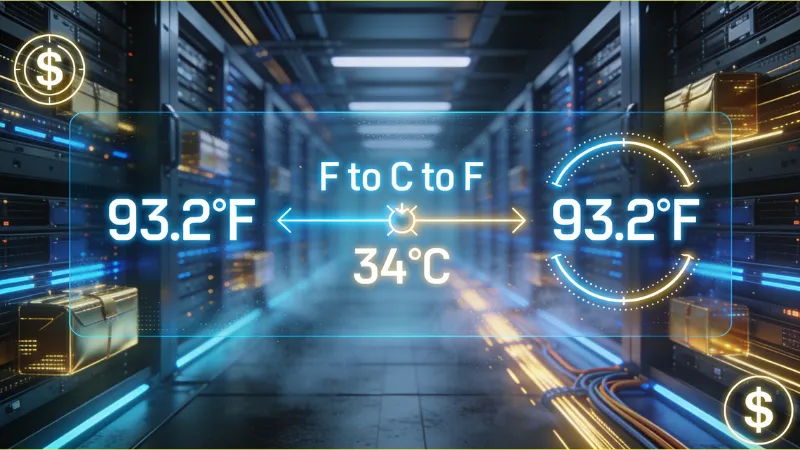
When a real-time bidding server datasheet specifies a maximum sustained inlet temperature of 34°C, the facilities team managing the AdTech operations center in New York needs to confirm that equals exactly 93.2°F — and when the building management system reads 93.2°F, they need to verify it converts back to precisely 34°C for the vendor compliance report. Cross-referencing ASHRAE A1 guidelines with vendor specifications across dozens of AdTech hardware SKUs requires seamless bidirectional Fahrenheit to Celsius to Fahrenheit accuracy at every decision point. A single misconfigured thermal setpoint can cascade into bid-response latency spikes, dropped auction participation, and millions of dollars in lost programmatic advertising revenue.
Real-Life Scenario: The Programmatic Revenue Meltdown
A leading programmatic advertising platform operates a real-time bidding infrastructure that processes 14 million bid requests per second for 800 demand-side clients during peak US evening hours. Their primary AdTech data hall houses high-density racks of bid-processing servers, audience segmentation appliances, and ad-creative rendering nodes. The vendor specification for the primary RTB server cluster states a maximum inlet temperature of 34°C. During a facility thermal audit, an engineer records the building management system reading of 92°F and manually converts it to 33.3°C for the vendor compliance spreadsheet — but the actual precise value is 33.33°C, which the engineer rounds down.
Three months later, during a major retail advertiser's Black Friday campaign surge, the data hall's thermal load peaks as bid volumes triple. The building management system alarm, calibrated using the rounded conversion, triggers two-tenths of a degree too late when converted back to Fahrenheit. By the time supplemental cooling activates, the RTB server cluster has entered thermal protection mode, increasing bid-response latency from 8 milliseconds to 340 milliseconds for seven minutes. During that window, the platform loses participation in 58 million auctions. Advertisers miss peak-hour impressions, the platform forfeits approximately $2.1 million in programmatic revenue, and three enterprise clients initiate contract review proceedings — all traceable to a single imprecise Fahrenheit to Celsius to Fahrenheit round-trip conversion during a routine thermal audit. Automated bidirectional precision eliminates that entire class of operational risk.
Fahrenheit to Celsius to Fahrenheit — Critical Thresholds in AdTech Operations
Below is a quick Fahrenheit to Celsius to Fahrenheit bidirectional reference table showing temperature benchmarks that marketing automation engineers, AdTech operations teams, and facility managers encounter daily:
| Infrastructure Context | °F Reading | °C Equivalent | Back to °F | Operational Risk if Incorrect |
|---|---|---|---|---|
| RTB Bid Server Inlet | 93.2°F | 34°C | 93.2°F | Bid-response latency spikes causing lost auction participation and revenue. |
| DSP Appliance Rack | 95°F | 35°C | 95°F | Thermal shutdown halting campaign delivery across advertiser portfolios. |
| CDP Processing Node | 80.6°F | 27°C | 80.6°F | CPU throttling degrading audience segmentation pipeline throughput. |
| Ad-Creative Render Cluster | 77°F | 25°C | 77°F | GPU throttling causing slow dynamic creative assembly for personalized ads. |
| UPS and Power Distribution | 68°F to 77°F | 20°C to 25°C | 68°F to 77°F | Accelerated battery degradation reducing backup runtime during outages. |
| Network Backbone Switch | 113°F | 45°C | 113°F | Packet loss between bidding nodes causing incomplete auction responses. |
The Fahrenheit to Celsius to Fahrenheit Formulas Explained
The Fahrenheit to Celsius to Fahrenheit conversion uses two complementary formulas. To convert Fahrenheit to Celsius: °C = (°F − 32) × 5 / 9. To convert Celsius back to Fahrenheit: °F = (°C × 9 / 5) + 32. When you apply both formulas sequentially, you complete a round-trip conversion that should return exactly to your original value — any discrepancy reveals a rounding error introduced during the process. While the arithmetic appears straightforward, performing either direction manually during an AdTech infrastructure thermal audit, a vendor compliance review, or a live programmatic platform incident introduces unacceptable rounding errors that compound when converted back. That is precisely why automated bidirectional Fahrenheit to Celsius to Fahrenheit tools exist: to guarantee decimal-level precision in both directions when programmatic advertising revenue depends on every fraction of a degree.
Common Fahrenheit to Celsius to Fahrenheit Values
Here are the most frequently referenced Fahrenheit to Celsius to Fahrenheit round-trip conversion points that AdTech platform engineers, marketing automation teams, and everyday users search for regularly:
| Fahrenheit (°F) | Celsius (°C) | Back to °F | Context |
|---|---|---|---|
| 32°F | 0°C | 32°F | Water freezing point |
| 64.4°F | 18°C | 64.4°F | ASHRAE A1 recommended lower limit for AdTech server halls |
| 71.6°F | 22°C | 71.6°F | Ideal marketing automation compute room setpoint |
| 77°F | 25°C | 77°F | UPS battery room upper boundary |
| 80.6°F | 27°C | 80.6°F | ASHRAE A1 recommended upper limit for data center environments |
| 93.2°F | 34°C | 93.2°F | Common RTB bid server max inlet temperature |
| 95°F | 35°C | 95°F | Standard DSP appliance max ambient threshold |
| 98.6°F | 37°C | 98.6°F | Normal human body temperature |
| 113°F | 45°C | 113°F | Network backbone switch max operating limit |
| 212°F | 100°C | 212°F | Water boiling point |
| -40°F | -40°C | -40°F | The point where both scales meet |
Frequently Asked Questions About Fahrenheit to Celsius to Fahrenheit
How do I convert Fahrenheit to Celsius to Fahrenheit?
To convert Fahrenheit to Celsius to Fahrenheit, use two formulas: first, °C = (°F − 32) × 5 / 9 to get Celsius, then °F = (°C × 9 / 5) + 32 to return to Fahrenheit. Our bidirectional tool handles both directions instantly — type into either field and the other updates automatically. For marketing automation infrastructure documentation and AdTech vendor compliance reports, we recommend using our automated tool to eliminate rounding errors entirely.
Why does bidirectional Fahrenheit to Celsius to Fahrenheit conversion matter for AdTech data centers?
AdTech hardware vendors and real-time bidding appliance manufacturers across Asia and Europe document thermal specifications in Celsius, while US-based marketing automation operations centers and facility management platforms operate in Fahrenheit. Bidirectional Fahrenheit to Celsius to Fahrenheit accuracy ensures that vendor compliance reports, BMS alarm configurations, and thermal audit documentation remain perfectly consistent in both directions — preventing the compounding rounding errors that cause ad-serving outages and programmatic revenue loss.
What is 98.6 Fahrenheit to Celsius to Fahrenheit?
98.6°F converts to 37°C, which converts back to exactly 98.6°F. This Fahrenheit to Celsius to Fahrenheit round-trip confirms precision. While 98.6°F is best known as normal human body temperature, it also falls near the upper operating boundary of many AdTech compute appliances.
At what temperature are Fahrenheit and Celsius values the same?
The Fahrenheit and Celsius temperature scales intersect at exactly −40 degrees. Therefore, −40 Fahrenheit to Celsius to Fahrenheit gives −40 at every step of the round-trip. This is the only point where the two scales are identical.
How can I download my Fahrenheit to Celsius to Fahrenheit result?
Click the "Download PDF Report" button above your Fahrenheit to Celsius to Fahrenheit result. Your browser will generate a free, clean PDF document of your current bidirectional calculation — ideal for attaching to AdTech infrastructure capacity planning briefs, vendor thermal compliance reports, or marketing automation platform audit documentation.
Is the Fahrenheit to Celsius to Fahrenheit tool on YellowPDF free?
Yes. Our Fahrenheit to Celsius to Fahrenheit tool is completely free to use with no registration required. We built it to serve AdTech platform engineers, marketing automation operations teams, programmatic trading desk facility managers, and anyone who needs accurate bidirectional temperature data on demand.
About YellowPDF
YellowPDF is a premier digital utility platform providing high-precision conversion tools and data resources. We developed this Fahrenheit to Celsius to Fahrenheit bidirectional tool to assist marketing automation operations teams, enterprise AdTech platform engineers, and programmatic advertising facility managers in eliminating manual calculation risks. Our algorithms are designed to ensure enterprise-level reliability while keeping our interface clean and free to use.